Support Kritika | Support H-Net | Buy Books Here | Join the NBN and NBN en Español on Patreon | Visit New Books Network en Español!
- African Studies
- African American Studies
- American Politics
- American Studies
- American South
- American West
- Asian American Studies
- Asian Politics
- Australian and New Zealand Studies
- British Studies
- Canadian Studies
- Caribbean Studies
- Central Asian Studies
- Chinese Studies
- East Asian Studies
- Eastern European Studies
- European Politics
- French Studies
- German Studies
- Iberian Studies
- India Studies
- Indian Ocean World
- Indigenous Studies
- Iranian Studies
- Irish Studies
- Israel Studies
- Italian Studies
- Japanese Studies
- Korean Studies
- Latino Studies
- Latin American Studies
- Mexican Studies
- Middle Eastern Studies
- Pacific Studies
- Polish Studies
- Russian and Eurasian Studies
- Southeast Asian Studies
- South Asian Studies
- Taiwan Studies
- Turkish Studies
- Ukrainian Studies
- Western European Studies
- World Affairs
- Animal Studies
- Anthropology
- Archaeology
- Business, Management, and Marketing
- Media and Communications
- Critical Theory
- Disability Studies
- Drugs, Addiction and Recovery
- Education
- Economics
- Finance
- Geography
- Gender Studies
- Genocide Studies
- Higher Education
- Human Rights
- Journalism
- Language and Translation
- Law
- LGBTQ+ Studies
- National Security
- Philanthropy
- Philosophy
- Policing, Incarceration, and Reform
- Political Science
- Politics & Polemics
- Postcolonial Studies
- Public Policy
- Sex, Sexuality, and Sex Work
- Sociology
- Sound Studies
- Sports
- Urban Studies
- Big Ideas
- Celebration Studies
- Co-Authored
- Cover Story
- Historical Materialism
- History Ex Silo
- Interpretive Political and Social Science
- Invested Investor
- Landscape Architecture
- Mormonism
- NBN Seminar
- New Books with Miranda Melcher
- On the Cusp: Between Strategy and Ethics
- Postscript: Conversations on Politics and Political Science
- Practical History
- Preparing for Life After Grad School
- Psychology and Climate Change
- Syriac Studies
- The Chair: In The Room at the Fed
- Oceanic Studies













































Apr 24, 2026
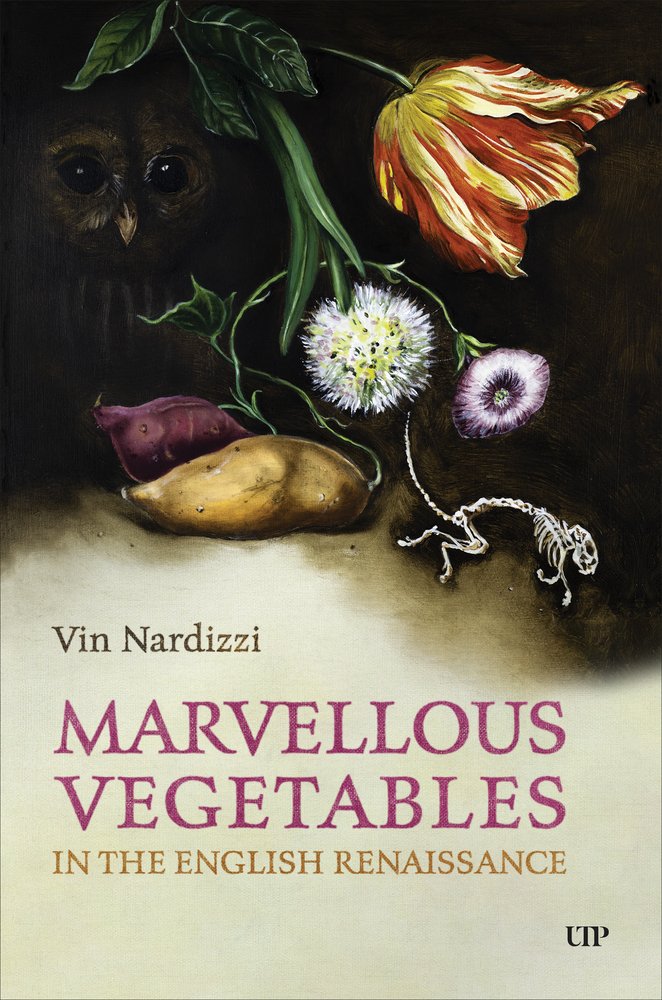
Marvellous Vegetables in the English Renaissance
Summary
Today, I interview Vin Nardizzi, Professor of English at the University of British Columbia, about his new monograph Marvellous Vegetables in the English Renaissance (U Toronto Press, 2025), published by the University of Toronto Press. Vin Nardizzi is the author of Wooden Os: Shakespeare’s Theatres and England’s Trees (University of Toronto, 2013). He is also the co-editor of Queer Renaissance Historiography: Backward Gaze (Ashgate, 2009) and The Indistinct Human in Renaissance Literature (Palgrave Macmillan, 2012).
In Marvellous Vegetables in the English Renaissance, a wide-ranging, elegantly written book, Vin argues that one of the major works of sixteenth-century plant writing, John Gerard’s The Herball, can reanimate our thinking about early modern literature and visual art. Marvellous Vegetables in the English Renaissance brings together a rich archive include Shakespeare’s Merry Wives of Windsor, Ovid’s Metamorphoses and its English translations, seventeenth-century anatomy textbooks, and the paintings of Giuseppe Arcimboldi and Nicholas Hilliard. The book also makes exciting methodological interventions in the critical practices of early modern scholarship.
Your Host
John Yargo
John Yargo is Assistant Professor of English at Boston College. He holds a Ph.D. in English from the University of Massachusetts Amherst. His specializations are early modern literature, the environmental humanities, and critical race studies. His dissertation explores early modern representations of environmental catastrophe, including William Shakespeare's The Tempest, Aphra Behn's Oroonoko, and John Milton's Paradise Lost. He has published in Early Theatre, Studies in Philology, The Journal for Early Modern Cultural Studies, and Shakespeare Studies.


