Support Kritika | Support H-Net | Buy Books Here | Join the NBN and NBN en Español on Patreon | Visit New Books Network en Español!
- African Studies
- African American Studies
- American Politics
- American Studies
- American South
- American West
- Asian American Studies
- Asian Politics
- Australian and New Zealand Studies
- British Studies
- Canadian Studies
- Caribbean Studies
- Central Asian Studies
- Chinese Studies
- East Asian Studies
- Eastern European Studies
- European Politics
- French Studies
- German Studies
- Iberian Studies
- India Studies
- Indian Ocean World
- Indigenous Studies
- Iranian Studies
- Irish Studies
- Israel Studies
- Italian Studies
- Japanese Studies
- Korean Studies
- Latino Studies
- Latin American Studies
- Mexican Studies
- Middle Eastern Studies
- Pacific Studies
- Polish Studies
- Russian and Eurasian Studies
- Southeast Asian Studies
- South Asian Studies
- Taiwan Studies
- Turkish Studies
- Ukrainian Studies
- Western European Studies
- World Affairs
- Animal Studies
- Anthropology
- Archaeology
- Business, Management, and Marketing
- Media and Communications
- Critical Theory
- Disability Studies
- Drugs, Addiction and Recovery
- Education
- Economics
- Finance
- Geography
- Gender Studies
- Genocide Studies
- Higher Education
- Human Rights
- Journalism
- Language and Translation
- Law
- LGBTQ+ Studies
- National Security
- Philanthropy
- Philosophy
- Policing, Incarceration, and Reform
- Political Science
- Politics & Polemics
- Postcolonial Studies
- Public Policy
- Sex, Sexuality, and Sex Work
- Sociology
- Sound Studies
- Sports
- Urban Studies
- Big Ideas
- Celebration Studies
- Co-Authored
- Cover Story
- Historical Materialism
- History Ex Silo
- Interpretive Political and Social Science
- Invested Investor
- Landscape Architecture
- Mormonism
- NBN Seminar
- New Books with Miranda Melcher
- On the Cusp: Between Strategy and Ethics
- Postscript: Conversations on Politics and Political Science
- Practical History
- Preparing for Life After Grad School
- Psychology and Climate Change
- Syriac Studies
- The Chair: In The Room at the Fed
- Oceanic Studies








































Jul 2, 2026
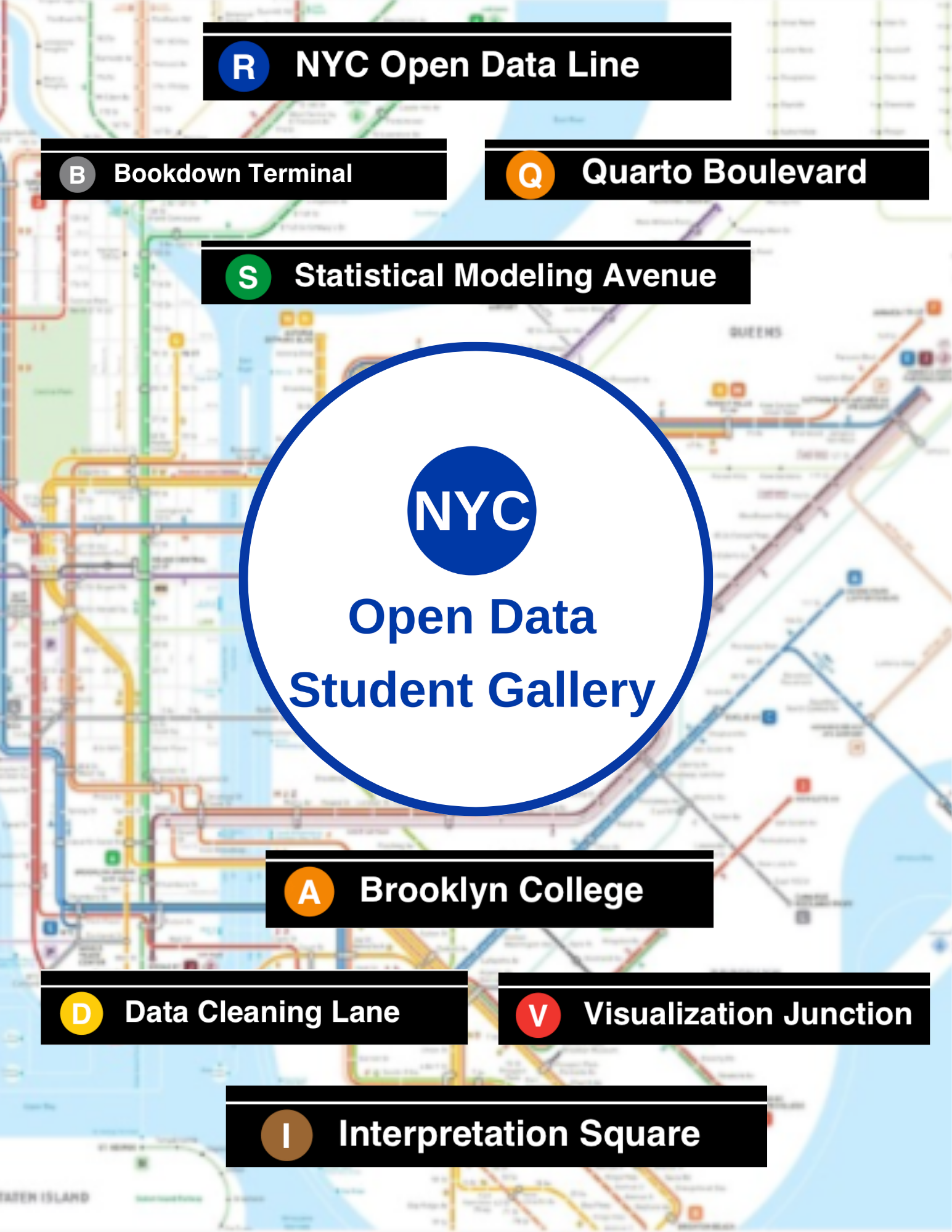
NYC Open Data Student Gallery
Summary
About NYC Open Data
During the Fall 2025 semester, students in the M.S. program in Psychological Research at Brooklyn College completed the inaugural offering of Reproducible Psychological Research. Using the R programming language, students developed weekly R Markdown documents to solve simulated real-world analytical problems using authentic datasets, with an emphasis on transparency, documentation, and reproducibility.
For their final projects, students were tasked with conducting independent, original research using open data related to New York City. Rather than working with pre-cleaned or artificial datasets, students engaged directly with messy, real-world data and were responsible for every step of the analytical workflow—from data acquisition and cleaning to analysis, visualization, and interpretation. A majority of projects utilized data from the NYC Open Data Portal, though students were encouraged to explore any open NYC-based data source that aligned with their research questions.
Each project in this volume represents a complete, reproducible research artifact. Students were required to meet the following criteria:
- The data must be openly available
- The data must meaningfully relate to New York City
- The research question, analysis, and interpretation must be original
Collectively, these projects demonstrate not only technical proficiency in R, but also the ability to ask meaningful questions about the city students live in, evaluate real-world data critically, and communicate findings in a clear, reproducible manner. This volume serves both as a showcase of student growth and as an example of how open data and open-source tools can be used to conduct rigorous, socially relevant research. Chapters are organized in alphabetical order of the student’s last names.
This volume is designed for students, educators, and practitioners interested in applied data analysis, reproducible research, and open data. Each chapter represents an independent research project and can be read on its own. Readers are encouraged to explore the accompanying code, reproduce analyses, and adapt methods for their own work.
Related Topics
Your Host
Gregory McNiff
Greg is the Executive Director and Founder of the World War II Discussion Forum (wwiidf.org). He also has a strong interest in literature, culture, religion, science and philosophy (translation: he's an eclectic reader who is constantly missing deadlines for book reviews).


Comments