Support Kritika | Support H-Net | Buy Books Here | Join the NBN and NBN en Español on Patreon | Visit New Books Network en Español!
- African Studies
- African American Studies
- American Politics
- American Studies
- American South
- American West
- Asian American Studies
- Asian Politics
- Australian and New Zealand Studies
- British Studies
- Canadian Studies
- Caribbean Studies
- Central Asian Studies
- Chinese Studies
- East Asian Studies
- Eastern European Studies
- European Politics
- French Studies
- German Studies
- Iberian Studies
- India Studies
- Indian Ocean World
- Indigenous Studies
- Iranian Studies
- Irish Studies
- Israel Studies
- Italian Studies
- Japanese Studies
- Korean Studies
- Latino Studies
- Latin American Studies
- Mexican Studies
- Middle Eastern Studies
- Pacific Studies
- Polish Studies
- Russian and Eurasian Studies
- Southeast Asian Studies
- South Asian Studies
- Taiwan Studies
- Turkish Studies
- Ukrainian Studies
- Western European Studies
- World Affairs
- Animal Studies
- Anthropology
- Archaeology
- Business, Management, and Marketing
- Media and Communications
- Critical Theory
- Disability Studies
- Drugs, Addiction and Recovery
- Education
- Economics
- Finance
- Geography
- Gender Studies
- Genocide Studies
- Higher Education
- Human Rights
- Journalism
- Language and Translation
- Law
- LGBTQ+ Studies
- National Security
- Philanthropy
- Philosophy
- Policing, Incarceration, and Reform
- Political Science
- Politics & Polemics
- Postcolonial Studies
- Public Policy
- Sex, Sexuality, and Sex Work
- Sociology
- Sound Studies
- Sports
- Urban Studies
- Big Ideas
- Celebration Studies
- Co-Authored
- Cover Story
- Historical Materialism
- History Ex Silo
- Interpretive Political and Social Science
- Invested Investor
- Landscape Architecture
- Mormonism
- NBN Seminar
- New Books with Miranda Melcher
- On the Cusp: Between Strategy and Ethics
- Postscript: Conversations on Politics and Political Science
- Practical History
- Preparing for Life After Grad School
- Psychology and Climate Change
- Syriac Studies
- The Chair: In The Room at the Fed
- Oceanic Studies
- Death in Westminster















































Nov 5, 2026
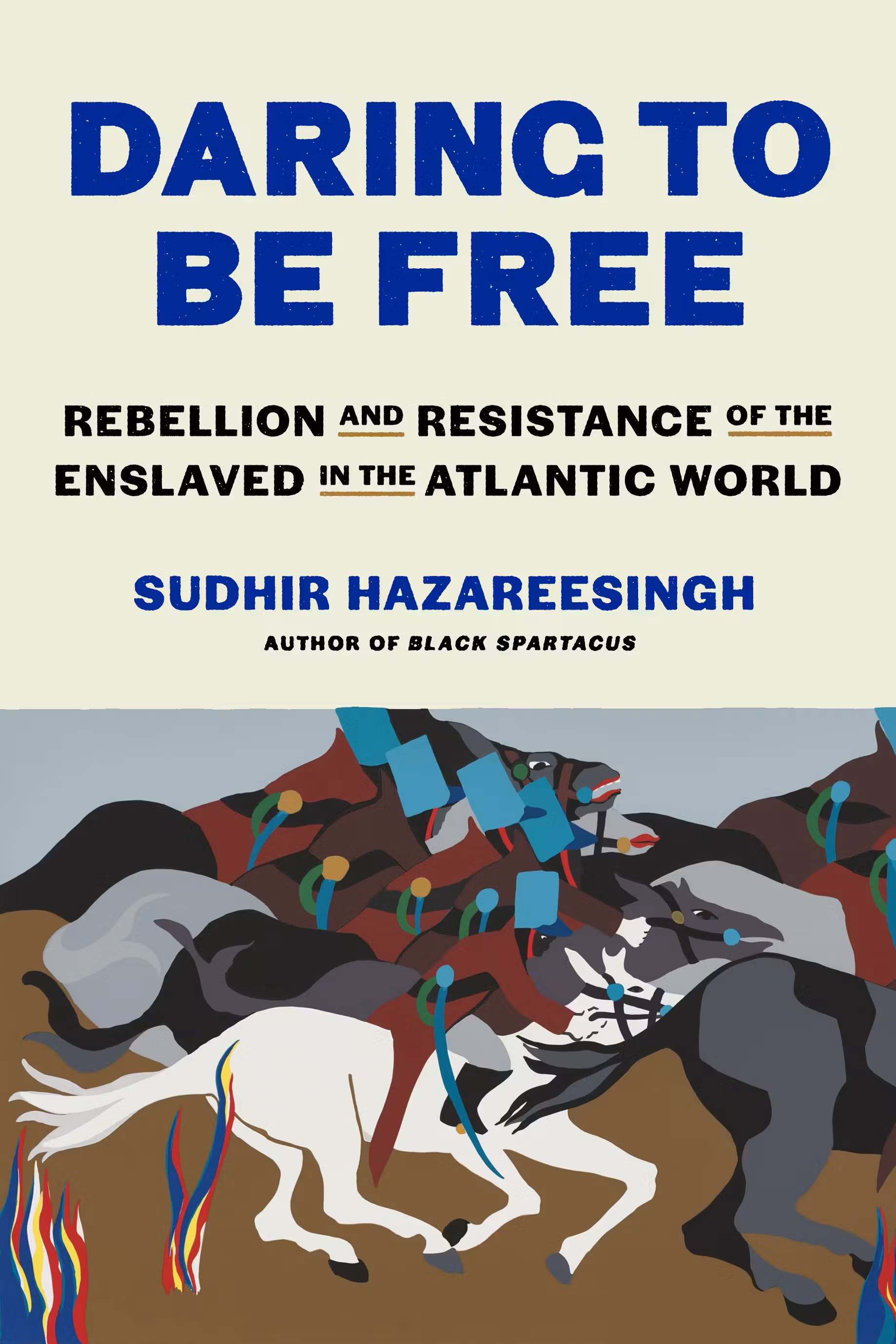
Daring to Be Free
Slave Marronage and Rebellion
Summary
Distinguished Oxford historian Sudhir Hazareesingh has written a stunning new study documenting the inevitable resistance that New World enslavement produced throughout its long terrible history. Joining John to speak with Sudhir is George Boulukos of SIU Carbondale, author of The Grateful Slave.
Daring to Be Free Rebellion and Resistance of the Enslaved in the Atlantic World (a suitable companion to Hazareesingh's earlier biography of the Haitian nation builder Toussaint Louverture, Black Spartacus) opens up four crucial topics that reshape the stories we tell about slavery's "social death.” One is persistent resistance during the Middle Passage, another is the omnipresence of successful marronage (meaning escape to highlands or remote refuges). Third is the strikingly omnipresent hope inspired by slaves' widespread knowledge the successful Haitian revolution. Finally, Sudhir emphasizes the striking way a sense of agency and autonomy among enslaved persons persisted in the New World–by way both of culture (frequently marked by durable religious practice) and by way of violent, frequently fatal rebellions, which were systematically under-acknowledged or swept under the rug within enslaving societies.
As he sums it up: "Resistance during middle passage, marronage, resistance based on culture, insurrections." Moreover, he persuasively makes the case that the role of benevolent actors within enslaving societies (the William Wilberforces of the world...) "has been greatly exaggerated, and in fact, their interventions were more often than not...actually prompted by the resistance of the enslaved themselves."
Mentioned in the episode:
Sylvaine Diouf on hinterland marronage, Slavery's Exiles: The Story of America's Maroons.
Aime Cesaire, "The Verb 'Marooner'" (1950, English version 1972)
Francois Mackandal: Haitian religious leader who alluded to and educated Haitians a longer pre-Revolutionary tradition there.
Julia C. Scott, The Common Wind. on communicative structures within the African-American slave world.
Orlando Patterson’s Slavery and Social Death: A Comparative Study (1982) introduced much-debated and frequently misunderstood category, one that is brilliantly explicated and extended by Vincent Brown, "Social Death and Political Life in the Study of Slavery." (2009).
Recallable Books
Rebecca Hall, Wake (graphic novel)
Marcelo D'Salete Angola Janga (Graphic novel about Brazilian Marronage)
C. L. R. James, Black Jacobins (1938)
Richard Price, First Time.
Neil Roberts, Freedom as Marronage (2015)
Related Topics
Your Host
Elizabeth Ferry and John Plotz
Free-ranging discussion of books from the past that cast a sideways light on today's world. Recall This Book is hosted by Elizabeth Ferry, Professor of Anthropology at Brandeis University and John Plotz, Barbara Mandel Professor of the Humanities at Brandeis University and co-founder of the Brandeis Educational Justice Initiative.


Comments