Support Kritika | Support H-Net | Buy Books Here | Join the NBN and NBN en Español on Patreon | Visit New Books Network en Español!
- African Studies
- African American Studies
- American Politics
- American Studies
- American South
- American West
- Asian American Studies
- Asian Politics
- Australian and New Zealand Studies
- British Studies
- Canadian Studies
- Caribbean Studies
- Central Asian Studies
- Chinese Studies
- East Asian Studies
- Eastern European Studies
- European Politics
- French Studies
- German Studies
- Iberian Studies
- India Studies
- Indian Ocean World
- Indigenous Studies
- Iranian Studies
- Irish Studies
- Israel Studies
- Italian Studies
- Japanese Studies
- Korean Studies
- Latino Studies
- Latin American Studies
- Mexican Studies
- Middle Eastern Studies
- Pacific Studies
- Polish Studies
- Russian and Eurasian Studies
- Southeast Asian Studies
- South Asian Studies
- Taiwan Studies
- Turkish Studies
- Ukrainian Studies
- Western European Studies
- World Affairs
- Animal Studies
- Anthropology
- Archaeology
- Business, Management, and Marketing
- Media and Communications
- Critical Theory
- Disability Studies
- Drugs, Addiction and Recovery
- Education
- Economics
- Finance
- Geography
- Gender Studies
- Genocide Studies
- Higher Education
- Human Rights
- Journalism
- Language and Translation
- Law
- LGBTQ+ Studies
- National Security
- Philanthropy
- Philosophy
- Policing, Incarceration, and Reform
- Political Science
- Politics & Polemics
- Postcolonial Studies
- Public Policy
- Sex, Sexuality, and Sex Work
- Sociology
- Sound Studies
- Sports
- Urban Studies
- Big Ideas
- Celebration Studies
- Co-Authored
- Cover Story
- Historical Materialism
- History Ex Silo
- Interpretive Political and Social Science
- Invested Investor
- Landscape Architecture
- Mormonism
- NBN Seminar
- New Books with Miranda Melcher
- On the Cusp: Between Strategy and Ethics
- Postscript: Conversations on Politics and Political Science
- Practical History
- Preparing for Life After Grad School
- Psychology and Climate Change
- Syriac Studies
- The Chair: In The Room at the Fed
- Oceanic Studies










































Jul 11, 2026
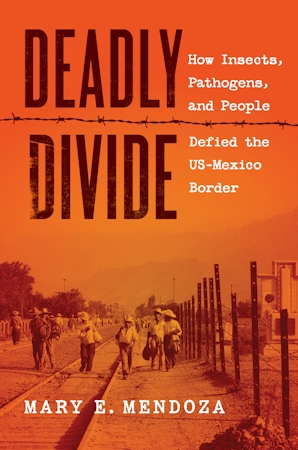
Deadly Divide
How Insects, Pathogens, and People Defied the US-Mexico Border
Summary
As many as ten thousand people attempt to illegally cross the border between the US and Mexico each month, braving deserts, rivers, and other environmental hazards in the process. But the very illegality of that crossing has an environmental history, writes Penn State University assistant professor Mary Mendoza in Deadly Divide: How Insects, Pathogens, and People Defied the US-Mexico Border (University of North Carolina Press, 2026). It was diseases, microbes, insects, and animals which, in part, hardened the border from a porous array of landscapes into the militarized zone seen on the news every night. However, despite the ecological and political difficulties of doing so, people continue to cross the border between the two countries, defying environmental odds and risking death along the way. In Deadly Divide, Mendoza explains why, underscores the risks involved, and shows how we got to this point, keeping an eye on the border region's stark landscape with every step of the way.
Your Host
Stephen Hausmann
Dr. Stephen R. Hausmann has been hosting New Books Network podcasts since 2017. Currently, he is a an assistant professor of American environmental history at Appalachian State University. He can be reached at hausmannsr@appstate.edu


Comments