Support Kritika | Support H-Net | Buy Books Here | Join the NBN and NBN en Español on Patreon | Visit New Books Network en Español!
- African Studies
- African American Studies
- American Politics
- American Studies
- American South
- American West
- Asian American Studies
- Asian Politics
- Australian and New Zealand Studies
- British Studies
- Canadian Studies
- Caribbean Studies
- Central Asian Studies
- Chinese Studies
- East Asian Studies
- Eastern European Studies
- European Politics
- French Studies
- German Studies
- Iberian Studies
- India Studies
- Indian Ocean World
- Indigenous Studies
- Iranian Studies
- Irish Studies
- Israel Studies
- Italian Studies
- Japanese Studies
- Korean Studies
- Latino Studies
- Latin American Studies
- Mexican Studies
- Middle Eastern Studies
- Pacific Studies
- Polish Studies
- Russian and Eurasian Studies
- Southeast Asian Studies
- South Asian Studies
- Taiwan Studies
- Turkish Studies
- Ukrainian Studies
- Western European Studies
- World Affairs
- Animal Studies
- Anthropology
- Archaeology
- Business, Management, and Marketing
- Media and Communications
- Critical Theory
- Disability Studies
- Drugs, Addiction and Recovery
- Education
- Economics
- Finance
- Geography
- Gender Studies
- Genocide Studies
- Higher Education
- Human Rights
- Journalism
- Language and Translation
- Law
- LGBTQ+ Studies
- National Security
- Philanthropy
- Philosophy
- Policing, Incarceration, and Reform
- Political Science
- Politics & Polemics
- Postcolonial Studies
- Public Policy
- Sex, Sexuality, and Sex Work
- Sociology
- Sound Studies
- Sports
- Urban Studies
- Big Ideas
- Celebration Studies
- Co-Authored
- Cover Story
- Historical Materialism
- History Ex Silo
- Interpretive Political and Social Science
- Invested Investor
- Landscape Architecture
- Mormonism
- NBN Seminar
- New Books with Miranda Melcher
- On the Cusp: Between Strategy and Ethics
- Postscript: Conversations on Politics and Political Science
- Practical History
- Preparing for Life After Grad School
- Psychology and Climate Change
- Syriac Studies
- The Chair: In The Room at the Fed
- Oceanic Studies













































Aug 25, 2026
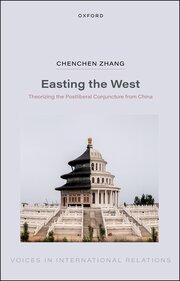
Easting the West
Theorizing the Postliberal Conjuncture from China
Summary
With commentary on the emergence of a ‘multipolar’ world, of transatlantic rifts and the rise of ‘middle powers’ ubiquitous, tales of the decline of something called ‘the West’ seem to be everywhere. Yet the meanings the idea of ‘the West’ acquires in spaces beyond it tell us at least as much about the state of the world as portents of its demise.
Based on a combination of cultural analysis of historical writings and—most strikingly—deep immersion in often very spicy Chinese social media fora, Chenchen Zhang’s new book Easting the West: Theorizing the Postliberal Conjuncture from China (Oxford University Press, 2026) theorises the shifting significations ascribed to ‘the West’ in China since the late-imperial collision with European empires. Whether imagined as a source of modernity, a colonial exploiter, geopolitical rival or—most recently—a civilisation sunk into decadence and decay, ‘the West’—Zhang shows—is a foil for China-based worldviews which, whatever their anticolonial or anti-Western sentiments, are also entangled with Eurocentric hierarchies of race, nation and gender whose patriarchal and civilisational histories are rooted at least partly that very same ‘West’.
Your Host
Ed Pulford
Ed Pulford is Professor of the Anthropology of Eurasia at the University of Manchester. His research focuses on friendships, nations and histories between the Chinese, Korean and Russian worlds, and experiences of socialism and empire in Eurasia.


Comments