Support Kritika | Support H-Net | Buy Books Here | Join the NBN and NBN en Español on Patreon | Visit New Books Network en Español!
- African Studies
- African American Studies
- American Politics
- American Studies
- American South
- American West
- Asian American Studies
- Asian Politics
- Australian and New Zealand Studies
- British Studies
- Canadian Studies
- Caribbean Studies
- Central Asian Studies
- Chinese Studies
- East Asian Studies
- Eastern European Studies
- European Politics
- French Studies
- German Studies
- Iberian Studies
- India Studies
- Indian Ocean World
- Indigenous Studies
- Iranian Studies
- Irish Studies
- Israel Studies
- Italian Studies
- Japanese Studies
- Korean Studies
- Latino Studies
- Latin American Studies
- Mexican Studies
- Middle Eastern Studies
- Pacific Studies
- Polish Studies
- Russian and Eurasian Studies
- Southeast Asian Studies
- South Asian Studies
- Taiwan Studies
- Turkish Studies
- Ukrainian Studies
- Western European Studies
- World Affairs
- Animal Studies
- Anthropology
- Archaeology
- Business, Management, and Marketing
- Media and Communications
- Critical Theory
- Disability Studies
- Drugs, Addiction and Recovery
- Education
- Economics
- Finance
- Geography
- Gender Studies
- Genocide Studies
- Higher Education
- Human Rights
- Journalism
- Language and Translation
- Law
- LGBTQ+ Studies
- National Security
- Philanthropy
- Philosophy
- Policing, Incarceration, and Reform
- Political Science
- Politics & Polemics
- Postcolonial Studies
- Public Policy
- Sex, Sexuality, and Sex Work
- Sociology
- Sound Studies
- Sports
- Urban Studies
- Big Ideas
- Celebration Studies
- Co-Authored
- Cover Story
- Historical Materialism
- History Ex Silo
- Interpretive Political and Social Science
- Invested Investor
- Landscape Architecture
- Mormonism
- NBN Seminar
- New Books with Miranda Melcher
- On the Cusp: Between Strategy and Ethics
- Postscript: Conversations on Politics and Political Science
- Practical History
- Preparing for Life After Grad School
- Psychology and Climate Change
- Syriac Studies
- The Chair: In The Room at the Fed
- Oceanic Studies












































Oct 12, 2025
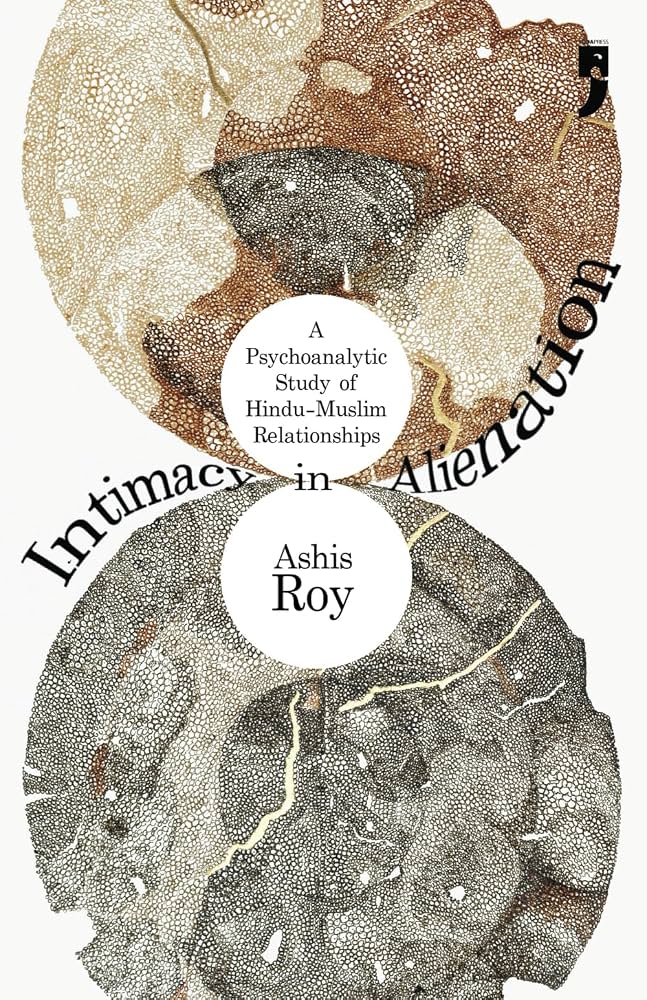
Intimacy in Alienation
A Psychoanalytic Study of Hindu-muslim Relationships
Summary
What happens when an analyst conducts interviews—and I am not speaking here about interviewing other analysts as we do at NBiP, but rather what happens when an analyst does field research, and researches one of the eternal subjects of our field which is to say love and also, to borrow from Gregorio Kohon, its’ vicissitudes?
Locating within himself demeaning feelings towards an other—and the setting is a psych ward in India, and in an India that continues to rework its having been partitioned, having partitioned itself, and the other is a Muslim other in a Hindu majority nation—the author, Ashis Roy, wants to know more about what he calls his “communal mind”, a mind that developed in a country where, “Muslims know the Hindu myths but the reverse is not true,” so a mind that was afforded an instant other to deposit its unwanted contents into.
His book, Intimacy in Alienation: A Psychoanalytic Study of Hindu-Muslim Relationships, explicates intimacy and asymmetry, as it delves into cross-religious desire, and in this case the forbidden desire of Hindus for Muslims, and Muslims for Hindus, which, when acknowledged, threatens social, familial, and cultural mores, and also the prerogatives of the state.
Who are these people, Roy asks, who take such a step, which is a step that can lead to a kind of social death, akin, in the American context from which I write, to the experience of gay people who come out and are brutally shorn of their families, communities, and sometimes their lives? The power of desire, a power beyond us, in excess of ourselves always, can propel us to this vertiginous place. Perhaps, and only perhaps, it can also push us to live in ways that reject socially and politically enforced liminality as well. One starts to imagine these couples, engaged ongoingly by Roy, as healing a malignant split that beats at the heart of contemporary Indian life.
Roy’s thinking draws from the myriad psychoanalytic theories of Kakar, Green, Erikson, Altman, Bollas, and Phillips, (among others), all of them kings of our trade, many of their names never uttered in the same breath—(I am thinking especially of Green and Altman.) Fascinatingly, he also orients himself to his material by engaging the work of two historians (queens of their own domains) and they are the American, Joan Wallach Scott and rather especially (or that is my read) the Italian scholar Luisa Passerini.
Like Roy, Passerini delved deeply into her own milieu, and like Roy she performed interviews with her peers who participated in what is commonly called the anni interessante in Italy (known for its red brigades, the murder of Aldo Moro, wildcat strikes in the auto industry alongside acts of student solidarity) all of which happened while she was in Africa. Her book, Autobiography of a Generation (1983), reads as an effort to be in touch with something fundamental about her homeland that she missed. My impression is that Intimacy in Alienation serves a similar purpose for Roy, who realizes that there is a world nearby that remained visually and affectively sidelined. Both wanted to see what had previously been, for various reasons, scotomized.
Notably, Passerini, (out of Africa) finds an analytic couch where she gives voice to both her heart and her generation, and like Roy, (both of them analyzed people) she conducts interviews wearing two hats—she is both an historian and also an analysand while he is both a social researcher and a psychoanalyst. It delights me to think that perhaps Passerini served as a reliable companion for Roy, with their shared hunger to understand an experience both ubiquitous and elusive, everywhere yet just out of reach, the kind of ephemera that is the highlight of a good analytic session come to think of it. Like Passerini, (who interviews people who committed violent acts driven by political passion, their lives never the same in the aftermath) Roy has given us a book that illuminates the ways in which desire can tip us over, exposing fissures in the social order, reuniting us with lost parts of ourselves, exiling us from the quotidian while opening the door for the potential creation of necessary and new ways of being.
Related Topics
Your Host
Tracy Morgan
Tracy D. Morgan: Psychoanalyst, LCSW-R, M.Phil., Editor, New Books in Psychoanalysis. Contact her at tracedoris@gmail.com


