Support Kritika | Support H-Net | Buy Books Here | Join the NBN and NBN en Español on Patreon | Visit New Books Network en Español!
- African Studies
- African American Studies
- American Politics
- American Studies
- American South
- American West
- Asian American Studies
- Asian Politics
- Australian and New Zealand Studies
- British Studies
- Canadian Studies
- Caribbean Studies
- Central Asian Studies
- Chinese Studies
- East Asian Studies
- Eastern European Studies
- European Politics
- French Studies
- German Studies
- Iberian Studies
- India Studies
- Indian Ocean World
- Indigenous Studies
- Iranian Studies
- Irish Studies
- Israel Studies
- Italian Studies
- Japanese Studies
- Korean Studies
- Latino Studies
- Latin American Studies
- Mexican Studies
- Middle Eastern Studies
- Pacific Studies
- Polish Studies
- Russian and Eurasian Studies
- Southeast Asian Studies
- South Asian Studies
- Taiwan Studies
- Turkish Studies
- Ukrainian Studies
- Western European Studies
- World Affairs
- Animal Studies
- Anthropology
- Archaeology
- Business, Management, and Marketing
- Media and Communications
- Critical Theory
- Disability Studies
- Drugs, Addiction and Recovery
- Education
- Economics
- Finance
- Geography
- Gender Studies
- Genocide Studies
- Higher Education
- Human Rights
- Journalism
- Language and Translation
- Law
- LGBTQ+ Studies
- National Security
- Philanthropy
- Philosophy
- Policing, Incarceration, and Reform
- Political Science
- Politics & Polemics
- Postcolonial Studies
- Public Policy
- Sex, Sexuality, and Sex Work
- Sociology
- Sound Studies
- Sports
- Urban Studies
- Big Ideas
- Celebration Studies
- Co-Authored
- Cover Story
- Historical Materialism
- History Ex Silo
- Interpretive Political and Social Science
- Invested Investor
- Landscape Architecture
- Mormonism
- NBN Seminar
- New Books with Miranda Melcher
- On the Cusp: Between Strategy and Ethics
- Postscript: Conversations on Politics and Political Science
- Practical History
- Preparing for Life After Grad School
- Psychology and Climate Change
- Syriac Studies
- The Chair: In The Room at the Fed
- Oceanic Studies
































Oct 21, 2026
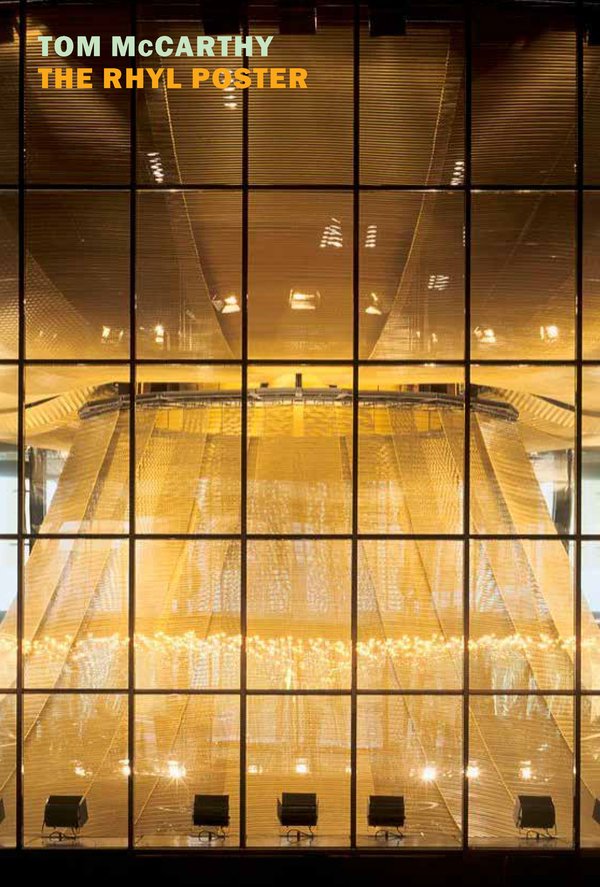
The Rhyl Poster
Summary
Describing the plot of a Tom McCarthy novel requires some caveats about the scale and the projection of the thing. One might begin with a description of a man who after suffering a head injury decides to recreate and reenact a day in his life again and again ad absurdum to the point of violence, but this would be insufficient as a depiction of the novel Remainder’s electrical currents of feeling and its intellectual conduits that flip switches on and off in literary theory and philosophy. Likewise, a gloss of Satin Island might rest on the project of its narrator, a corporate archeologist preparing an all-encompassing ethnography of our human era. But such a distillation misses the humor, intrigue, and dreamwork that make the novel an island unto itself. And these baffling plots give way to novels that as the AV club has written, “are more entertaining than [they] have any right to be”.
Such is the case with McCarthy’s latest novel, The Rhyl Poster (Jonathan Cape, 2026), a thriller punched through with intrigue, violence, international skullduggery, and a flawed hero weighing his personal code against the ethical nature of global law and community making. Our protagonist, Stanton, the author of legal decisions of great acclaim for The European Court of Justice, is renowned for his digressive logic and absolute professionalism, but he has got himself into some trouble. When an addiction to pain killers puts him in the crosshairs for espionage at the court, Stanton will have to consider how the ideals of the court and his own language of ethical responsibility collide with his actions in a case that has world reorganizing implications.
But this description fails mightily to describe the experience of reading The Rhyl Poster, a novel that plays in the theater of many different forms of logic and representation. Stanton will, for example, fall into the game world of Grand Theft Auto and experience himself as an infinite chameleon of the open world mode, he will process his own childhood stutter as a means of introducing doubt and reconsideration into his speech and writing, and he will explore the possibilities of other means of thinking and being as far afield from his everyday life as kite concerts and Indonesian shadow puppetry. To read The Rhyl Poster is to surrender to its thinking processes and to understand that literature need not be monolithic in its representational instincts. It is a book that challenges as it entertains, and as such, it finds good company with classical words of philosophical fiction, Dostoyevsky, Elliott, Joyce.
Tom McCarthy’s work has been translated into more than twenty languages and adapted for cinema, theatre and radio. His first novel, Remainder, won the Believer Book Award. His third novel, C, was shortlisted for the Booker Prize, the Walter Scott Prize and the Europese Literaturrprijs and his fourth, Satin Island, was shortlisted for the Booker Prize and the Goldsmiths Prize. In 2013 he was awarded the inaugural Windham Campbell Literature Prize. McCarthy is also author of the study Tintin and the Secret of Literature and the essay collection Typewriters, Bombs, and Jellyfish. He lives in Berlin.
Recommended Books:
- Mary Shelley, Frankenstein
- George Eliot, Middlemarch
Chris Holmes is Chair of Literatures in English and Professor at Ithaca College. He writes criticism on contemporary global literatures. His book, Kazuo Ishiguro Against World Literature, is published with Bloomsbury Publishing. He is the co-director of The New Voices Festival, a celebration of work in poetry, prose, and playwriting by up-and-coming young writers.
Related Topics
Your Host
Chris Holmes
Chris Holmes is Professor of Literatures in English at Ithaca College. He writes criticism on contemporary global literatures. His book, Kazuo Ishiguro as World Literature is published with Bloomsbury Publishing. He is the co-director of The New Voices Festival, a celebration of work in poetry, prose, and playwriting by up-and-coming young writers.


Comments