Support Kritika | Support H-Net | Buy Books Here | Join the NBN and NBN en Español on Patreon | Visit New Books Network en Español!
- African Studies
- African American Studies
- American Politics
- American Studies
- American South
- American West
- Asian American Studies
- Asian Politics
- Australian and New Zealand Studies
- British Studies
- Canadian Studies
- Caribbean Studies
- Central Asian Studies
- Chinese Studies
- East Asian Studies
- Eastern European Studies
- European Politics
- French Studies
- German Studies
- Iberian Studies
- India Studies
- Indian Ocean World
- Indigenous Studies
- Iranian Studies
- Irish Studies
- Israel Studies
- Italian Studies
- Japanese Studies
- Korean Studies
- Latino Studies
- Latin American Studies
- Mexican Studies
- Middle Eastern Studies
- Pacific Studies
- Polish Studies
- Russian and Eurasian Studies
- Southeast Asian Studies
- South Asian Studies
- Taiwan Studies
- Turkish Studies
- Ukrainian Studies
- Western European Studies
- World Affairs
- Animal Studies
- Anthropology
- Archaeology
- Business, Management, and Marketing
- Media and Communications
- Critical Theory
- Disability Studies
- Drugs, Addiction and Recovery
- Education
- Economics
- Finance
- Geography
- Gender Studies
- Genocide Studies
- Higher Education
- Human Rights
- Journalism
- Language and Translation
- Law
- LGBTQ+ Studies
- National Security
- Philanthropy
- Philosophy
- Policing, Incarceration, and Reform
- Political Science
- Politics & Polemics
- Postcolonial Studies
- Public Policy
- Sex, Sexuality, and Sex Work
- Sociology
- Sound Studies
- Sports
- Urban Studies
- Big Ideas
- Celebration Studies
- Co-Authored
- Cover Story
- Historical Materialism
- History Ex Silo
- Interpretive Political and Social Science
- Invested Investor
- Landscape Architecture
- Mormonism
- NBN Seminar
- New Books with Miranda Melcher
- On the Cusp: Between Strategy and Ethics
- Postscript: Conversations on Politics and Political Science
- Practical History
- Preparing for Life After Grad School
- Psychology and Climate Change
- Syriac Studies
- The Chair: In The Room at the Fed
- Oceanic Studies













































Mar 12, 2026
Imperial Depths
Mark Letteney and Matthew Larsen on the Roman Prison System
Summary
The notion of abolishing prisons strikes some as an impossible dream: could we could reasonably conceive of a society that responded to harm without the possibility of long-term confinement in purpose-built institutions? To others, we already have a template. Didn’t Michel Foucault long ago show us that prisons as they exist now–in all their horror, in all their commitment not just to jail people before trial but also to imprison them afterwards–come about only in the modern episteme, concomitant with capitalism and all sorts of attendant evils?
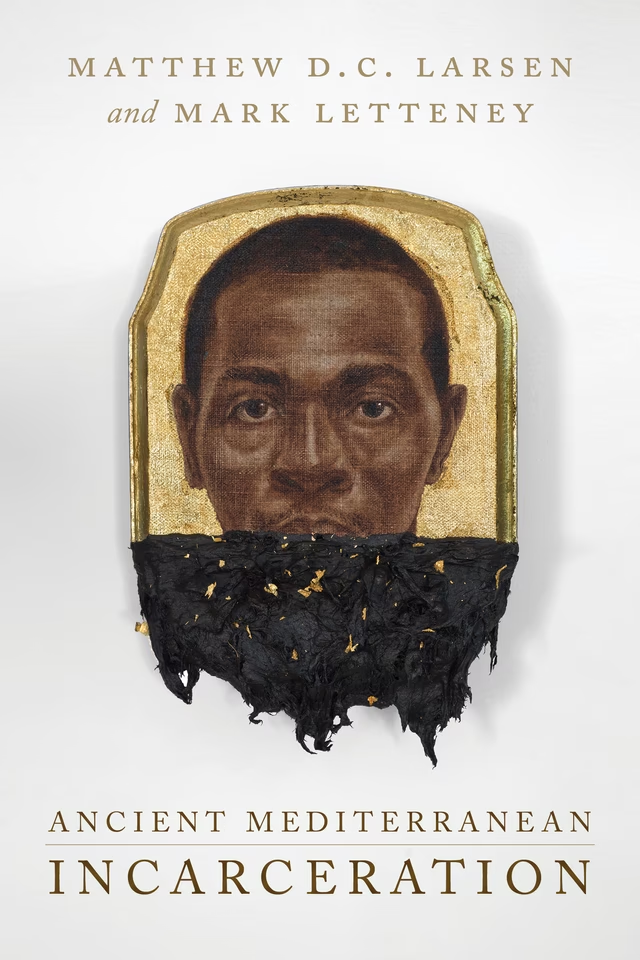
Actually, nope. Prisons are as old as the Romans and very likely much older than that. In Ancient Mediterranean Incarceration (California, 2025). Mark Letteney (a U Washington historian who wrote The Christianization of Knowledge in Late Antiquity)directs excavations in a legionary amphitheater) and Matthew Larsen (University of Copenhagen, author of Gospels before the Book) document an ancient and durable prison system system with five key features: Centrality, surveillance, separation depth, and punitive variability.
Their RTB conversation explores key aspects of that system and its present-day legacy or parallels. Yet it ends on a note of cautious optimism from Letteney: just because we don’t find a prison-free world in ancient Rome is no reason to give up the struggle. Whatever better solution to societal safety and rehabilitation awaits us in the future, it must be something we ourselves set out to build anew.
Mentioned
- Michel Foucault’s foundational Discipline and Punish (1975)
- Adam Gopknik reviews Ancient Mediterranean Incarceration in The New Yorker
- The Rules of Ulpian (3rd century jurist)
- Wengrow and Graeber’s foundational and heavily debated The Dawn of Everything (2021)
- Spencer Weinreich’s work on solitary confinement)
- Erving Goffman Stigma (1963) and Asylums (1961)
- Livy (eg in his History of Rome on prisons and prisoners
- Who Would Believe a Prisoner? Edited by Michelle Daniel Jones and Elizabeth Angeline Nelson
- Libanius (on the abuse of Prisoners)
- Fyodor Dostoyevsky. The House of the Dead
- Samuel Delany Tales of Neveryon
Your Host
Elizabeth Ferry and John Plotz
Free-ranging discussion of books from the past that cast a sideways light on today's world. Recall This Book is hosted by Elizabeth Ferry, Professor of Anthropology at Brandeis University and John Plotz, Barbara Mandel Professor of the Humanities at Brandeis University and co-founder of the Brandeis Educational Justice Initiative.


Comments