Support Kritika | Support H-Net | Buy Books Here | Join the NBN and NBN en Español on Patreon | Visit New Books Network en Español!
- African Studies
- African American Studies
- American Politics
- American Studies
- American South
- American West
- Asian American Studies
- Asian Politics
- Australian and New Zealand Studies
- British Studies
- Canadian Studies
- Caribbean Studies
- Central Asian Studies
- Chinese Studies
- East Asian Studies
- Eastern European Studies
- European Politics
- French Studies
- German Studies
- Iberian Studies
- India Studies
- Indian Ocean World
- Indigenous Studies
- Iranian Studies
- Irish Studies
- Israel Studies
- Italian Studies
- Japanese Studies
- Korean Studies
- Latino Studies
- Latin American Studies
- Mexican Studies
- Middle Eastern Studies
- Pacific Studies
- Polish Studies
- Russian and Eurasian Studies
- Southeast Asian Studies
- South Asian Studies
- Taiwan Studies
- Turkish Studies
- Ukrainian Studies
- Western European Studies
- World Affairs
- Animal Studies
- Anthropology
- Archaeology
- Business, Management, and Marketing
- Media and Communications
- Critical Theory
- Disability Studies
- Drugs, Addiction and Recovery
- Education
- Economics
- Finance
- Geography
- Gender Studies
- Genocide Studies
- Higher Education
- Human Rights
- Journalism
- Language and Translation
- Law
- LGBTQ+ Studies
- National Security
- Philanthropy
- Philosophy
- Policing, Incarceration, and Reform
- Political Science
- Politics & Polemics
- Postcolonial Studies
- Public Policy
- Sex, Sexuality, and Sex Work
- Sociology
- Sound Studies
- Sports
- Urban Studies
- Big Ideas
- Celebration Studies
- Co-Authored
- Cover Story
- Historical Materialism
- History Ex Silo
- Interpretive Political and Social Science
- Invested Investor
- Landscape Architecture
- Mormonism
- NBN Seminar
- New Books with Miranda Melcher
- On the Cusp: Between Strategy and Ethics
- Postscript: Conversations on Politics and Political Science
- Practical History
- Preparing for Life After Grad School
- Psychology and Climate Change
- Syriac Studies
- The Chair: In The Room at the Fed
- Oceanic Studies














































Aug 24, 2026
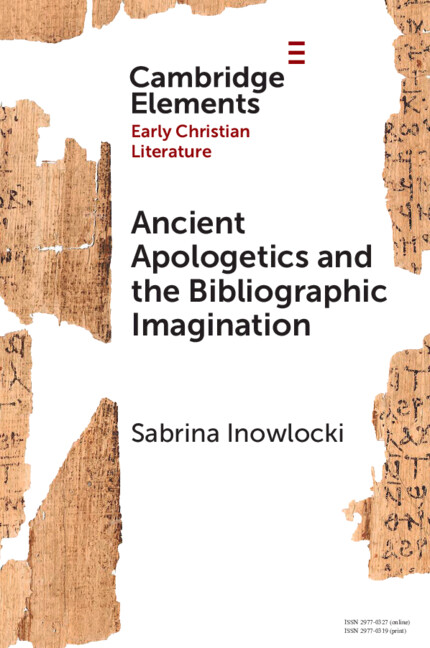
Ancient Apologetics and the Bibliographic Imagination
Summary
Ancient apologetics is usually treated as a literary genre or a branch of early theology. This Element offers a different account. It argues that many Jewish and Christian texts conventionally labeled 'apologetic' are better understood through a bibliographic and archival lens: They produce authority not only by defending doctrines, but by organizing books, constructing corpora, mobilizing archives, and regulating interpretation. Tracing a trajectory from the Letter of Aristeas to Jerome's De viris illustribus, this Element shows how citation, collection, cataloguing, and textual ordering made traditions appear authoritative. Examining Aristeas, Josephus, Tatian, Justin, Origen, Pamphilus, Eusebius, and Jerome, it argues that apologetics is best understood as a form of curatorial power through which ancient communities learned to think with books. This title is also available as open access on Cambridge Core.
New Books in Late Antiquity is presented by Ancient Jew Review.
Sabrina Inowlocki is a Senior Research Fellow Institute for Religion and Critical Inquiry (IRCI) at the Australian Catholic University.
Michael Motia teaches in Classics and Religious Studies at UMass Boston
Your Host
Michael Motia
Michael Motia teaches in Religious Studies and Classics at UMass Boston.


Comments