Support Kritika | Support H-Net | Buy Books Here | Join the NBN and NBN en Español on Patreon | Visit New Books Network en Español!
- African Studies
- African American Studies
- American Politics
- American Studies
- American South
- American West
- Asian American Studies
- Asian Politics
- Australian and New Zealand Studies
- British Studies
- Canadian Studies
- Caribbean Studies
- Central Asian Studies
- Chinese Studies
- East Asian Studies
- Eastern European Studies
- European Politics
- French Studies
- German Studies
- Iberian Studies
- India Studies
- Indian Ocean World
- Indigenous Studies
- Iranian Studies
- Irish Studies
- Israel Studies
- Italian Studies
- Japanese Studies
- Korean Studies
- Latino Studies
- Latin American Studies
- Mexican Studies
- Middle Eastern Studies
- Pacific Studies
- Polish Studies
- Russian and Eurasian Studies
- Southeast Asian Studies
- South Asian Studies
- Taiwan Studies
- Turkish Studies
- Ukrainian Studies
- Western European Studies
- World Affairs
- Animal Studies
- Anthropology
- Archaeology
- Business, Management, and Marketing
- Media and Communications
- Critical Theory
- Disability Studies
- Drugs, Addiction and Recovery
- Education
- Economics
- Finance
- Geography
- Gender Studies
- Genocide Studies
- Higher Education
- Human Rights
- Journalism
- Language and Translation
- Law
- LGBTQ+ Studies
- National Security
- Philanthropy
- Philosophy
- Policing, Incarceration, and Reform
- Political Science
- Politics & Polemics
- Postcolonial Studies
- Public Policy
- Sex, Sexuality, and Sex Work
- Sociology
- Sound Studies
- Sports
- Urban Studies
- Big Ideas
- Celebration Studies
- Co-Authored
- Cover Story
- Historical Materialism
- History Ex Silo
- Interpretive Political and Social Science
- Invested Investor
- Landscape Architecture
- Mormonism
- NBN Seminar
- New Books with Miranda Melcher
- On the Cusp: Between Strategy and Ethics
- Postscript: Conversations on Politics and Political Science
- Practical History
- Preparing for Life After Grad School
- Psychology and Climate Change
- Syriac Studies
- The Chair: In The Room at the Fed
- Oceanic Studies














































Mar 23, 2026
Prolepsis
Summary
In this episode of High Theory, Gloria Fisk talks to Kim about Prolepsis. Defined by Gerard Genette in the 1970s, prolepsis is a flash forward, the opposite of analepsis, a flash back. Initially the province of high modernism, this rhetorical device has become a well-worn trope with a surprising aptitude for representing violence in our current moment. Fisk shows us how prolepsis dramatizes the workings of structural violence in narrative form.
In the episode, Gloria references Stokely Carmichael and Charles Hamilton’s Black Power: The Politics of Liberation (Random House 1967) and Michael Dango's Crisis Style: The Aesthetics of Repair (Stanford UP 2021). The transcript lives here as a WordDoc and here as a PDF.
Gloria Fisk writes about contemporary literature in a global context, with a particular interest in the novel. She works as an associate professor of English at Queens College, CUNY. Her areas of interest include the critical debates surrounding world literature in the U.S. as well as novel theory, postcolonial studies, translation theory, and critical writing.
In her first book, Orhan Pamuk and the Good of World Literature (Columbia UP 2018), Gloria reads the Turkish novelist Orhan Pamuk as a case study in the unevenness of Western canons’ expansion across the eastern border of Europe. She theorizes the ways the Turkish novelist arrives among his readers in the U.S. and Europe, where he meets a standard for literary value that that emerges in tandem with him.
In this episode, we discuss her current book project, in which Gloria theorizes the ethics and politics of prolepsis in contemporary world literature. Her project asks why so many novels that reach Anglophone readers today begin with a scene of terrible violence — a chemical spill, maybe, or untimely death at sea; incarceration, or a terrorist attack — to narrate in retrospect the paths that converge to create it? This use of prolepsis is historically specific to the contemporary period, so Gloria sets out to explain why. She shows that proleptic representations of violence were rare in Western literary traditions until the turn of the twenty-first century, but they have become ubiquitous now, because they work well to express new anxieties and hopes about the limits of our political communities, within and beyond the nation. The working title of her book is We Know How This Will End: Prolepsis, Tragedy, and the Representation of Structural Violence on a Global Scale. Look forward to seeing it in print!
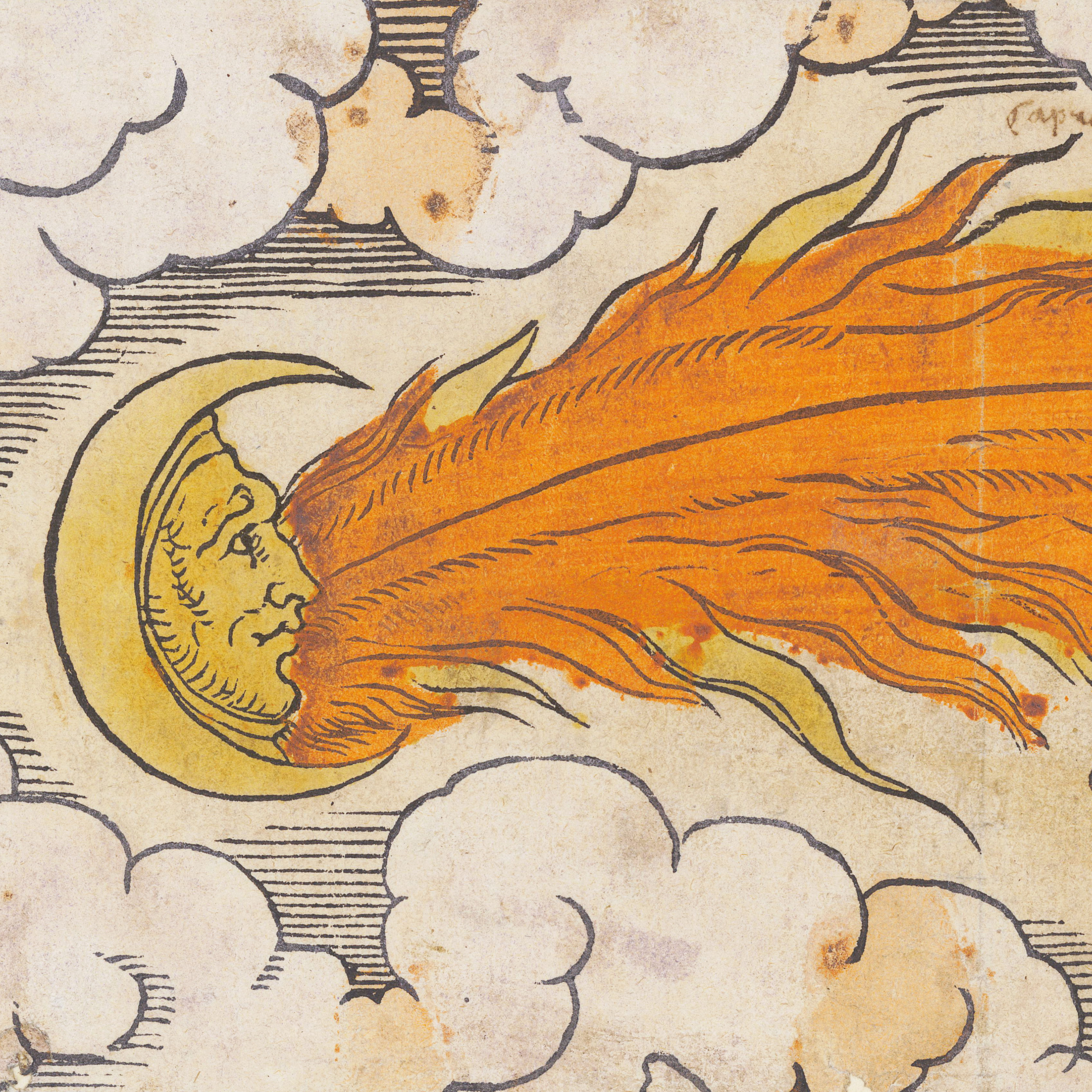
The image for this episode is an anonymous illustration from a 1554 broadsheet depicting celestial phenomenon over Salon-de-Provence. It was found for High Theory by Lily Epstein on the Public Domain Image Archive.


Comments