Support Kritika | Support H-Net | Buy Books Here | Join the NBN and NBN en Español on Patreon | Visit New Books Network en Español!
- African Studies
- African American Studies
- American Politics
- American Studies
- American South
- American West
- Asian American Studies
- Asian Politics
- Australian and New Zealand Studies
- British Studies
- Canadian Studies
- Caribbean Studies
- Central Asian Studies
- Chinese Studies
- East Asian Studies
- Eastern European Studies
- European Politics
- French Studies
- German Studies
- Iberian Studies
- India Studies
- Indian Ocean World
- Indigenous Studies
- Iranian Studies
- Irish Studies
- Israel Studies
- Italian Studies
- Japanese Studies
- Korean Studies
- Latino Studies
- Latin American Studies
- Mexican Studies
- Middle Eastern Studies
- Pacific Studies
- Polish Studies
- Russian and Eurasian Studies
- Southeast Asian Studies
- South Asian Studies
- Taiwan Studies
- Turkish Studies
- Ukrainian Studies
- Western European Studies
- World Affairs
- Animal Studies
- Anthropology
- Archaeology
- Business, Management, and Marketing
- Media and Communications
- Critical Theory
- Disability Studies
- Drugs, Addiction and Recovery
- Education
- Economics
- Finance
- Geography
- Gender Studies
- Genocide Studies
- Higher Education
- Human Rights
- Journalism
- Language and Translation
- Law
- LGBTQ+ Studies
- National Security
- Philanthropy
- Philosophy
- Policing, Incarceration, and Reform
- Political Science
- Politics & Polemics
- Postcolonial Studies
- Public Policy
- Sex, Sexuality, and Sex Work
- Sociology
- Sound Studies
- Sports
- Urban Studies
- Big Ideas
- Celebration Studies
- Co-Authored
- Cover Story
- Historical Materialism
- History Ex Silo
- Interpretive Political and Social Science
- Invested Investor
- Landscape Architecture
- Mormonism
- NBN Seminar
- New Books with Miranda Melcher
- On the Cusp: Between Strategy and Ethics
- Postscript: Conversations on Politics and Political Science
- Practical History
- Preparing for Life After Grad School
- Psychology and Climate Change
- Syriac Studies
- The Chair: In The Room at the Fed
- Oceanic Studies











































Oct 22, 2026
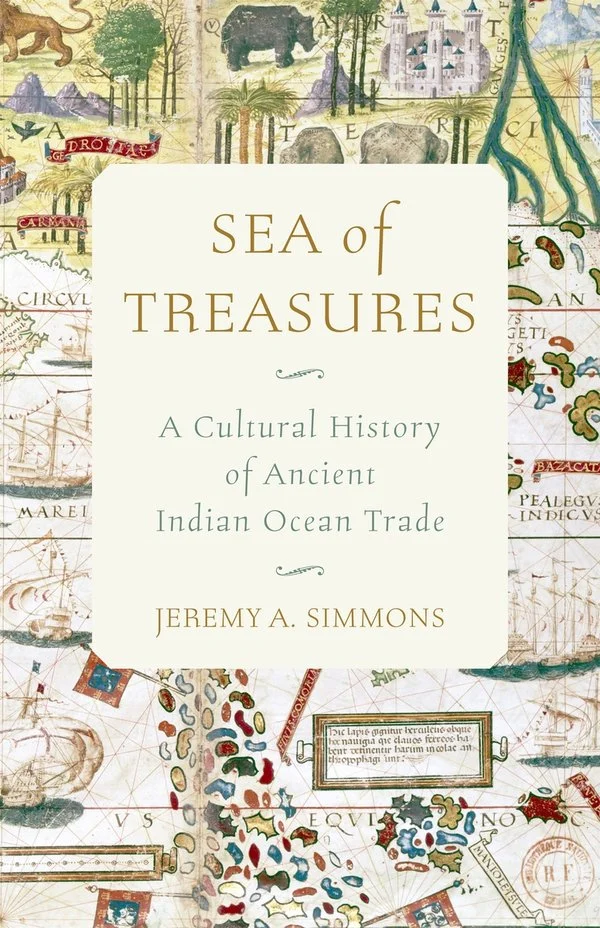
Sea of Treasures
A Cultural History of Ancient Indian Ocean Trade
Summary
After Caesar's assassination, the triumvirs drew up a kill list; one such target, a man named Lucius Plotius Plancus, fled to a villa near Naples and tried hiding behind a curtain. The soldiers found him anyway–thanks to his heavy perfume.
Pliny the Elder, writing a century later, used the perfume to suggest the killing was justified. Historians have often taken that at face value, as proof that Rome despised Eastern luxuries. Jeremy Simmons reads it as a joke—Pliny was calling the man a walking corpse.
In Jeremy’s latest book Sea of Treasures: A Cultural History of Ancient Indian Ocean Trade (Princeton, July 2026) he asks what happened when goods like pepper and perfume arrived at their destinations. The goods took on new lives: perfume became a way of talking about death, pepper a medicine prescribed for its heat, Roman coins turned pendants in South Asia—or how soldiers knew the price of spices even on remote Hadrian’s Wall.
Jeremy is an assistant professor of history and the college at the University of Chicago.
You can find more reviews, excerpts, interviews, and essays at The Asian Review of Books, including its review of Sea of Treasures. Follow on Twitter at @BookReviewsAsia.
Nicholas Gordon is an editor for a global magazine, and a reviewer for the Asian Review of Books. He can be found on Twitter at @nickrigordon.
Your Host
Nicholas Gordon
Nicholas Gordon is an associate editor for a global magazine, and a reviewer for the Asian Review of Books. He can be found on Twitter at @nickrigordon.



Comments