Support Kritika | Support H-Net | Buy Books Here | Join the NBN and NBN en Español on Patreon | Visit New Books Network en Español!
- African Studies
- African American Studies
- American Politics
- American Studies
- American South
- American West
- Asian American Studies
- Asian Politics
- Australian and New Zealand Studies
- British Studies
- Canadian Studies
- Caribbean Studies
- Central Asian Studies
- Chinese Studies
- East Asian Studies
- Eastern European Studies
- European Politics
- French Studies
- German Studies
- Iberian Studies
- India Studies
- Indian Ocean World
- Indigenous Studies
- Iranian Studies
- Irish Studies
- Israel Studies
- Italian Studies
- Japanese Studies
- Korean Studies
- Latino Studies
- Latin American Studies
- Mexican Studies
- Middle Eastern Studies
- Pacific Studies
- Polish Studies
- Russian and Eurasian Studies
- Southeast Asian Studies
- South Asian Studies
- Taiwan Studies
- Turkish Studies
- Ukrainian Studies
- Western European Studies
- World Affairs
- Animal Studies
- Anthropology
- Archaeology
- Business, Management, and Marketing
- Media and Communications
- Critical Theory
- Disability Studies
- Drugs, Addiction and Recovery
- Education
- Economics
- Finance
- Geography
- Gender Studies
- Genocide Studies
- Higher Education
- Human Rights
- Journalism
- Language and Translation
- Law
- LGBTQ+ Studies
- National Security
- Philanthropy
- Philosophy
- Policing, Incarceration, and Reform
- Political Science
- Politics & Polemics
- Postcolonial Studies
- Public Policy
- Sex, Sexuality, and Sex Work
- Sociology
- Sound Studies
- Sports
- Urban Studies
- Big Ideas
- Celebration Studies
- Co-Authored
- Cover Story
- Historical Materialism
- History Ex Silo
- Interpretive Political and Social Science
- Invested Investor
- Landscape Architecture
- Mormonism
- NBN Seminar
- New Books with Miranda Melcher
- On the Cusp: Between Strategy and Ethics
- Postscript: Conversations on Politics and Political Science
- Practical History
- Preparing for Life After Grad School
- Psychology and Climate Change
- Syriac Studies
- The Chair: In The Room at the Fed
- Oceanic Studies





































Oct 8, 2026
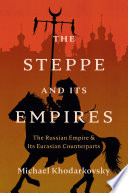
The Steppe and Its Empires
The Russian Empire and Its Eurasian Counterparts
Summary
Winston Churchill famously called Russia "a riddle, wrapped in a mystery, inside an enigma." But what if the riddle is partly of our own making—the product of a habit of looking only west for answers? Michael Khodarkovsky today argues that to understand Russia, we need to look east, to the steppe and the empires it shaped.
Michael’s new book, The Steppe and Its Empires: The Russian Empire and Its Eurasian Counterparts (Yale UP, 2026), sets Russia beside the Ottoman, Persian, and Mughal empires in order to uncover the things that connect them: universal monarchy, reliance on outsider elites, law in the service of the state. From the Mongol conquest to Putin's Russia. the steppe ends up explaining more than we’d expect it to.
Michael is a professor of history at Loyola University Chicago. He is the author, most recently, of Russia’s 20th Century: A Journey in 100 Histories and Russia’s Steppe Frontier: The Making of a Colonial Empire, 1500–1800.
You can find more reviews, excerpts, interviews, and essays at The Asian Review of Books, including its review of The Steppe and Its Empires. Follow on Twitter at @BookReviewsAsia.
Nicholas Gordon is an editor for a global magazine, and a reviewer for the Asian Review of Books. He can be found on Twitter at @nickrigordon.
Your Host
Nicholas Gordon
Nicholas Gordon is an associate editor for a global magazine, and a reviewer for the Asian Review of Books. He can be found on Twitter at @nickrigordon.


Comments