Support Kritika | Support H-Net | Buy Books Here | Join the NBN and NBN en Español on Patreon | Visit New Books Network en Español!
- African Studies
- African American Studies
- American Politics
- American Studies
- American South
- American West
- Asian American Studies
- Asian Politics
- Australian and New Zealand Studies
- British Studies
- Canadian Studies
- Caribbean Studies
- Central Asian Studies
- Chinese Studies
- East Asian Studies
- Eastern European Studies
- European Politics
- French Studies
- German Studies
- Iberian Studies
- India Studies
- Indian Ocean World
- Indigenous Studies
- Iranian Studies
- Irish Studies
- Israel Studies
- Italian Studies
- Japanese Studies
- Korean Studies
- Latino Studies
- Latin American Studies
- Mexican Studies
- Middle Eastern Studies
- Pacific Studies
- Polish Studies
- Russian and Eurasian Studies
- Southeast Asian Studies
- South Asian Studies
- Taiwan Studies
- Turkish Studies
- Ukrainian Studies
- Western European Studies
- World Affairs
- Animal Studies
- Anthropology
- Archaeology
- Business, Management, and Marketing
- Media and Communications
- Critical Theory
- Disability Studies
- Drugs, Addiction and Recovery
- Education
- Economics
- Finance
- Geography
- Gender Studies
- Genocide Studies
- Higher Education
- Human Rights
- Journalism
- Language and Translation
- Law
- LGBTQ+ Studies
- National Security
- Philanthropy
- Philosophy
- Policing, Incarceration, and Reform
- Political Science
- Politics & Polemics
- Postcolonial Studies
- Public Policy
- Sex, Sexuality, and Sex Work
- Sociology
- Sound Studies
- Sports
- Urban Studies
- Big Ideas
- Celebration Studies
- Co-Authored
- Cover Story
- Historical Materialism
- History Ex Silo
- Interpretive Political and Social Science
- Invested Investor
- Landscape Architecture
- Mormonism
- NBN Seminar
- New Books with Miranda Melcher
- On the Cusp: Between Strategy and Ethics
- Postscript: Conversations on Politics and Political Science
- Practical History
- Preparing for Life After Grad School
- Psychology and Climate Change
- Syriac Studies
- The Chair: In The Room at the Fed
- Oceanic Studies
- Death in Westminster

















































Nov 5, 2026
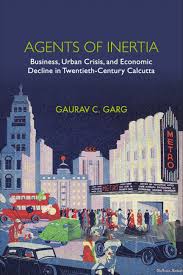
Agents of Inertia
Business, Urban Crisis, and Economic Decline in Twentieth-Century Calcutta
Summary
In the first half of the twentieth century, Asia's colonial trade, commerce, and enterprise pivoted on five cities- Shanghai, Hong Kong, Singapore, Calcutta, and Bombay. Today, among these, only Calcutta no longer plays a significant role in the Asian or global economy. Why? Agents of Inertia: Business, Urban Crisis, and Economic Decline in Twentieth-Century Calcutta (Cambridge UP, 2026) answers this question by investigating how Calcutta's British and Indian businesses have engaged with the city's infrastructural and economic challenges. It throws up a startling result: through the first seven decades of twentieth century, Calcutta's businesses, in contrast to their counterparts elsewhere, staunchly resisted several measures that intended to update and improve the city's infrastructure. It is this resistance, Agents of Inertia argues, that led to Calcutta's postcolonial urban crisis and contributed to capital- flight and economic decline. One of the first full-length monographs on Calcutta's postcolonial urban-economic decline, it shows how big businesses not only make but can also break a city's fortunes.
Gaurav C. Garg is a historian of modern South Asia, cities, mountains, and international development at Ashoka University, Delhi NCR.
Soumyadeep Guha is a fifth-year PhD student in the History Department at Binghamton University, New York. He is interested in historical research focusing on themes such as Agrarian/Environmental History, History of Science and Tech, Global History, and their intersections. His prospective dissertation questions are on the pre-history of the ‘Green Revolution’ in Eastern India.


Comments