Support Kritika | Support H-Net | Buy Books Here | Join the NBN and NBN en Español on Patreon | Visit New Books Network en Español!
- African Studies
- African American Studies
- American Politics
- American Studies
- American South
- American West
- Asian American Studies
- Asian Politics
- Australian and New Zealand Studies
- British Studies
- Canadian Studies
- Caribbean Studies
- Central Asian Studies
- Chinese Studies
- East Asian Studies
- Eastern European Studies
- European Politics
- French Studies
- German Studies
- Iberian Studies
- India Studies
- Indian Ocean World
- Indigenous Studies
- Iranian Studies
- Irish Studies
- Israel Studies
- Italian Studies
- Japanese Studies
- Korean Studies
- Latino Studies
- Latin American Studies
- Mexican Studies
- Middle Eastern Studies
- Pacific Studies
- Polish Studies
- Russian and Eurasian Studies
- Southeast Asian Studies
- South Asian Studies
- Taiwan Studies
- Turkish Studies
- Ukrainian Studies
- Western European Studies
- World Affairs
- Animal Studies
- Anthropology
- Archaeology
- Business, Management, and Marketing
- Media and Communications
- Critical Theory
- Disability Studies
- Drugs, Addiction and Recovery
- Education
- Economics
- Finance
- Geography
- Gender Studies
- Genocide Studies
- Higher Education
- Human Rights
- Journalism
- Language and Translation
- Law
- LGBTQ+ Studies
- National Security
- Philanthropy
- Philosophy
- Policing, Incarceration, and Reform
- Political Science
- Politics & Polemics
- Postcolonial Studies
- Public Policy
- Sex, Sexuality, and Sex Work
- Sociology
- Sound Studies
- Sports
- Urban Studies
- Big Ideas
- Celebration Studies
- Co-Authored
- Cover Story
- Historical Materialism
- History Ex Silo
- Interpretive Political and Social Science
- Invested Investor
- Landscape Architecture
- Mormonism
- NBN Seminar
- New Books with Miranda Melcher
- On the Cusp: Between Strategy and Ethics
- Postscript: Conversations on Politics and Political Science
- Practical History
- Preparing for Life After Grad School
- Psychology and Climate Change
- Syriac Studies
- The Chair: In The Room at the Fed
- Oceanic Studies







































Aug 10, 2026
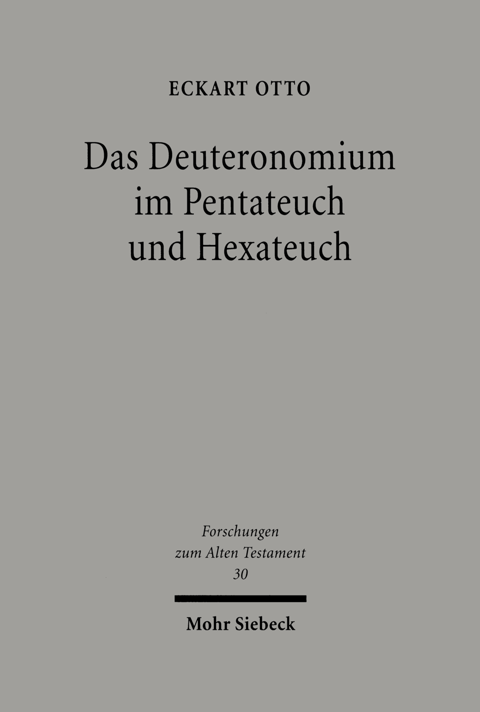
Deuteronomy in the Pentateuch and the Hexateuch
Studies of the Literary History of the Pentateuch and the Hexateuch within the Framework of Deuteronomy
Summary
In Deuteronomy in the Pentateuch and the Hexateuch: Studies of the Literary History of the Pentateuch and the Hexateuch within the Framework of Deuteronomy (Mohr Siebeck, 2000; unrevised e-book edition, 2019), Eckart Otto contributes to the study of Deuteronomy, the Pentateuch, the Hexateuch. The book argues that both the Hexateuch and the Pentateuch developed ideas already articulated in the Deuteronomistic form of Deuteronomy. Deuteronomy therefore appears not simply as one component of the Pentateuch, but as a central point of departure for understanding the formation of larger compositions.
Otto places Deuteronomy at the centre of the literary history of ancient Israel. Rather than treating Deuteronomy, the Priestly Writing, Joshua, and Pentateuchal traditions as isolated units, he reconstructs the processes through which these texts were connected, revised, and reinterpreted. The combination of the Priestly Writing with Deuteronomy and the Deuteronomistic Book of Joshua produced a Hexateuchal composition extending from Genesis through Joshua. A later Pentateuchal redaction separated the Torah from Joshua and placed Deuteronomy’s covenant at Horeb at its centre.
The Hexateuch reaches its narrative conclusion with Israel’s arrival in the promised land, while the Pentateuch ends with Moses and Israel still outside the land. This makes Torah and covenant, rather than possession of the land, central to Israel’s identity. Otto also argues that Hexateuchal and Pentateuchal redactors did not merely use a completed Deuteronomy; they reshaped Deuteronomy itself to serve their conceptions of covenant, law, land, and Israel’s relationship with God.
Deuteronomy contributed to the emergence of the Hexateuch and Pentateuch, but the later redactions of these larger works also transformed Deuteronomy. Otto connects these literary developments with conflicts among priestly groups in the Persian period and with debates over priesthood, law, authority, identity, and inherited traditions.
Through this approach, Otto challenges the traditional separation between Pentateuchal and Deuteronomic research. His study also has implications for the hypothesis of a “Deuteronomistic History,” inviting scholars to reconsider the relationship between Deuteronomy, Joshua, the historical books, the Priestly Writing, and the final form of the Torah. It also contributes to discussions of biblical historiography, authoritative scripture, law and narrative, and the Torah’s emergence as Judaism’s foundational text.
In this New Books Network interview, Professor Otto explains the book’s central arguments in his own words. The conversation addresses the relationship between Pentateuch and Hexateuch, the integration of Priestly and Deuteronomistic traditions, the role of Joshua, the covenant at Horeb, and the priestly conflicts that shaped the Torah in the Persian period.
This conversation is a companion to Željko Stanojević’s interview with Eckart Otto about Max Weber’s Studies of Ancient Judaism: The Historical Foundation for a Theory of the Modern Age.
Professor Dr. Dr. h.c. Eckart Otto is a distinguished German theologian and biblical scholar, known for his work on Deuteronomy, the Pentateuch, biblical law, the Hebrew Bible, and ancient Near Eastern legal traditions. He is Professor Emeritus of Old Testament and Hebrew Bible at Ludwig Maximilian University of Munich and a member of the Editorial Board of the European Hebrew Journal.
This interview is hosted by Professor Željko Stanojević, a Serbian-Israeli Hebraist, biblical philologist, lexicographer, translator, and Semitic-language researcher. He is President of the Institute for Hebrew Language and Literature, Founder and Editor-in-Chief of the European Hebrew Journal, and a host on the New Books Network.
Related Topics
Your Host
Željko Stanojević
Prof. Željko Stanojević, editor in chief of European Hebrew Journal https://ehj.hebrew.edu.rs/inde...


Comments