Support Kritika | Support H-Net | Buy Books Here | Join the NBN and NBN en Español on Patreon | Visit New Books Network en Español!
- African Studies
- African American Studies
- American Politics
- American Studies
- American South
- American West
- Asian American Studies
- Asian Politics
- Australian and New Zealand Studies
- British Studies
- Canadian Studies
- Caribbean Studies
- Central Asian Studies
- Chinese Studies
- East Asian Studies
- Eastern European Studies
- European Politics
- French Studies
- German Studies
- Iberian Studies
- India Studies
- Indian Ocean World
- Indigenous Studies
- Iranian Studies
- Irish Studies
- Israel Studies
- Italian Studies
- Japanese Studies
- Korean Studies
- Latino Studies
- Latin American Studies
- Mexican Studies
- Middle Eastern Studies
- Pacific Studies
- Polish Studies
- Russian and Eurasian Studies
- Southeast Asian Studies
- South Asian Studies
- Taiwan Studies
- Turkish Studies
- Ukrainian Studies
- Western European Studies
- World Affairs
- Animal Studies
- Anthropology
- Archaeology
- Business, Management, and Marketing
- Media and Communications
- Critical Theory
- Disability Studies
- Drugs, Addiction and Recovery
- Education
- Economics
- Finance
- Geography
- Gender Studies
- Genocide Studies
- Higher Education
- Human Rights
- Journalism
- Language and Translation
- Law
- LGBTQ+ Studies
- National Security
- Philanthropy
- Philosophy
- Policing, Incarceration, and Reform
- Political Science
- Politics & Polemics
- Postcolonial Studies
- Public Policy
- Sex, Sexuality, and Sex Work
- Sociology
- Sound Studies
- Sports
- Urban Studies
- Big Ideas
- Celebration Studies
- Co-Authored
- Cover Story
- Historical Materialism
- History Ex Silo
- Interpretive Political and Social Science
- Invested Investor
- Landscape Architecture
- Mormonism
- NBN Seminar
- New Books with Miranda Melcher
- On the Cusp: Between Strategy and Ethics
- Postscript: Conversations on Politics and Political Science
- Practical History
- Preparing for Life After Grad School
- Psychology and Climate Change
- Syriac Studies
- The Chair: In The Room at the Fed
- Oceanic Studies











































Aug 17, 2026
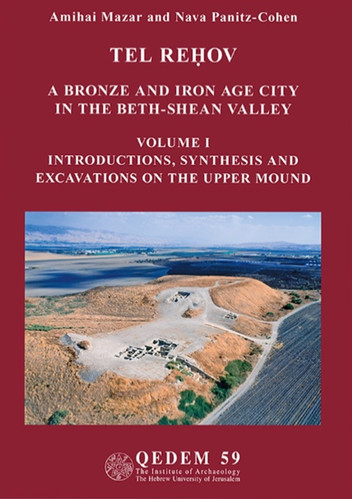
Tel Rehov
A Bronze and Iron Age City in the Beth-Shean Valle
Summary
This interview with Professor Amihai Mazar was conducted by Željko Stanojević for the New Books Network. The conversation focuses on Tel Reḥov: A Bronze and Iron Age City in the Beth-Shean Valley, especially Volume V, where the report turns from architecture and pottery to smaller objects and scientific evidence that help reconstruct life at the site.
Amihai Mazar is a leading archaeologist of ancient Israel. His research examines the Bronze and Iron Ages, archaeology and biblical history, ancient Near Eastern art and architecture, and historical geography. Tel Reḥov is especially important because it offers a rich archaeological sequence from the Beth-Shean Valley and evidence for the social, economic, and environmental history of northern Israel.
Volume V is particularly revealing because it asks what can be learned from material that might appear secondary beside monumental architecture. Its first part examines clay, bone, stone and gypsum vessels; grinding stones and other stone implements; metal objects and metallurgical evidence; beads; objects connected with textile production; scale weights; and lithics. Together, these finds illuminate household work, craft activity, exchange, measurement, and technology.
The volume also analyzes the spatial distribution of finds in a distinctive group of ninth-century BCE buildings in Area C. Archaeology is also about understanding where objects were found and how groups of finds functioned together. Distribution patterns can help reconstruct activities within buildings and suggest how work, storage, production, and daily routines were organized. It also includes Assyrian-period burials and later Islamic-period material, showing the site's long history.
The second part of Volume V brings natural-science methods directly into the archaeological interpretation. Radiometric dating contributes to chronology. Studies of animal and fish remains, molluscs, and botanical material offer evidence for diet, agriculture, environment, trade, and the use of local and non-local resources. A soil-flotation project recovers small botanical remains that might otherwise disappear from the archaeological record. These studies show how modern archaeology depends on collaboration between excavators and natural-science specialists.
One striking example is the paleomagnetic study of tilted walls in Area C, Stratum V. Instead of treating damaged architecture only as a descriptive feature, the researchers used physical evidence to investigate seismic destruction. This demonstrates a central strength of Volume V: interpretation is built by combining objects, context, chronology, biological remains, geology, and physical-science methods.
Our discussion with Professor Mazar therefore uses Volume V to ask a larger question: how do small finds and scientific analyses change the historical picture created by excavation? The volume shows that understanding an ancient city requires more than identifying buildings or connecting archaeological horizons with historical narratives. It requires reconstructing technologies, food systems, craft production, movement of goods, environmental conditions, patterns of use within buildings, and the events that transformed them.
Željko Stanojević is a host with the New Books Network and President of the Institute for Hebrew Language and Literature, Belgrade. He is also Founder and Editor-in-Chief of the European Hebrew Journal, an international Diamond Open Access journal supporting research in Hebrew, biblical, Jewish, linguistic, historical, and related studies. He also coordinates the European Hebrew Journal International Online Conference, New Discoveries and New Directions in Biblical, Hebrew, and Theological Studies. Authors of recent academic books are welcome to contact him regarding possible New Books Network interviews.
Your Host
Željko Stanojević
Prof. Željko Stanojević, editor in chief of European Hebrew Journal https://ehj.hebrew.edu.rs/inde...


Comments