Support Kritika | Support H-Net | Buy Books Here | Join the NBN and NBN en Español on Patreon | Visit New Books Network en Español!
- African Studies
- African American Studies
- American Politics
- American Studies
- American South
- American West
- Asian American Studies
- Asian Politics
- Australian and New Zealand Studies
- British Studies
- Canadian Studies
- Caribbean Studies
- Central Asian Studies
- Chinese Studies
- East Asian Studies
- Eastern European Studies
- European Politics
- French Studies
- German Studies
- Iberian Studies
- India Studies
- Indian Ocean World
- Indigenous Studies
- Iranian Studies
- Irish Studies
- Israel Studies
- Italian Studies
- Japanese Studies
- Korean Studies
- Latino Studies
- Latin American Studies
- Mexican Studies
- Middle Eastern Studies
- Pacific Studies
- Polish Studies
- Russian and Eurasian Studies
- Southeast Asian Studies
- South Asian Studies
- Taiwan Studies
- Turkish Studies
- Ukrainian Studies
- Western European Studies
- World Affairs
- Animal Studies
- Anthropology
- Archaeology
- Business, Management, and Marketing
- Media and Communications
- Critical Theory
- Disability Studies
- Drugs, Addiction and Recovery
- Education
- Economics
- Finance
- Geography
- Gender Studies
- Genocide Studies
- Higher Education
- Human Rights
- Journalism
- Language and Translation
- Law
- LGBTQ+ Studies
- National Security
- Philanthropy
- Philosophy
- Policing, Incarceration, and Reform
- Political Science
- Politics & Polemics
- Postcolonial Studies
- Public Policy
- Sex, Sexuality, and Sex Work
- Sociology
- Sound Studies
- Sports
- Urban Studies
- Big Ideas
- Celebration Studies
- Co-Authored
- Cover Story
- Historical Materialism
- History Ex Silo
- Interpretive Political and Social Science
- Invested Investor
- Landscape Architecture
- Mormonism
- NBN Seminar
- New Books with Miranda Melcher
- On the Cusp: Between Strategy and Ethics
- Postscript: Conversations on Politics and Political Science
- Practical History
- Preparing for Life After Grad School
- Psychology and Climate Change
- Syriac Studies
- The Chair: In The Room at the Fed
- Oceanic Studies
- Death in Westminster
- The Last Jury Trial in India















































Nov 14, 2026
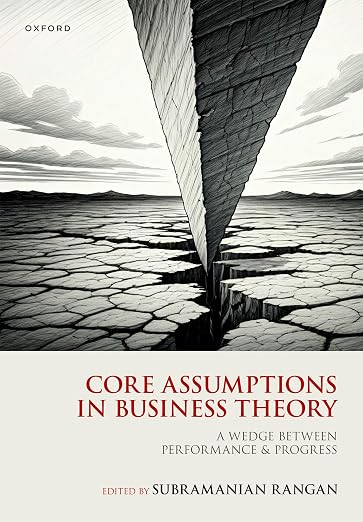
Core Assumptions in Business Theory
A Wedge Between Performance and Progress
Summary
The modern market-based economy generates wealth, but it lags on well-being; it has mastered efficiency, but struggles with equity; it boasts size, but falls short on sustainability. In other words, our economy delivers performance but neglects progress (i.e., well-being, equity, and sustainability). Many rightly call for tighter regulation, higher (“true”) prices, and longer-term incentives. Others appeal to corporate purpose, shared value, and stakeholder-centricity.
Beyond regulation and the practice of business, we must attend as well to education and the theory of business. In particular, we must look at business theory's core assumptions, whose weaknesses are long known. In an applied field such as business, where theory tends to be normative, flawed assumptions could act as a “wedge” cleaving apart performance and progress.
In Core Assumptions in Business Theory: A Wedge Between Performance and Progress (Oxford UP, 2025), Subramanian Rangan brings together eminent social scientists and philosophers to explore core assumptions in each of the major fields of business-including economics, strategy, marketing, operations, decision science, leadership, governance, technology, and finance. This structured field-by-field reflection reveals and expands the bounds of our rationality. Core Assumptions in Business Theory proposes a revised profit function that integrates harm, outlines how economic actors may draw on moral philosophy to enact Pareto-equity (and not just Pareto-efficiency), suggests a two-stage rationality approach that can attend to well-being, and recasts marketing as consumer education and not merely demand promotion.
With an emphasis on education rather than regulation of economic power, this volume argues that moral reasoning and moral roles can fruitfully supplement prudential reasoning and functional responsibilities. Such an evolution will enable our economy to be both modern and moral.
This is an open access title available under the terms of a CC BY-NC-ND 4.0 International licence. It is free to read on the Oxford Academic platform and offered as a free PDF download from OUP and selected open access locations.


Comments