Support Kritika | Support H-Net | Buy Books Here | Join the NBN and NBN en Español on Patreon | Visit New Books Network en Español!
- African Studies
- African American Studies
- American Politics
- American Studies
- American South
- American West
- Asian American Studies
- Asian Politics
- Australian and New Zealand Studies
- British Studies
- Canadian Studies
- Caribbean Studies
- Central Asian Studies
- Chinese Studies
- East Asian Studies
- Eastern European Studies
- European Politics
- French Studies
- German Studies
- Iberian Studies
- India Studies
- Indian Ocean World
- Indigenous Studies
- Iranian Studies
- Irish Studies
- Israel Studies
- Italian Studies
- Japanese Studies
- Korean Studies
- Latino Studies
- Latin American Studies
- Mexican Studies
- Middle Eastern Studies
- Pacific Studies
- Polish Studies
- Russian and Eurasian Studies
- Southeast Asian Studies
- South Asian Studies
- Taiwan Studies
- Turkish Studies
- Ukrainian Studies
- Western European Studies
- World Affairs
- Animal Studies
- Anthropology
- Archaeology
- Business, Management, and Marketing
- Media and Communications
- Critical Theory
- Disability Studies
- Drugs, Addiction and Recovery
- Education
- Economics
- Finance
- Geography
- Gender Studies
- Genocide Studies
- Higher Education
- Human Rights
- Journalism
- Language and Translation
- Law
- LGBTQ+ Studies
- National Security
- Philanthropy
- Philosophy
- Policing, Incarceration, and Reform
- Political Science
- Politics & Polemics
- Postcolonial Studies
- Public Policy
- Sex, Sexuality, and Sex Work
- Sociology
- Sound Studies
- Sports
- Urban Studies
- Big Ideas
- Celebration Studies
- Co-Authored
- Cover Story
- Historical Materialism
- History Ex Silo
- Interpretive Political and Social Science
- Invested Investor
- Landscape Architecture
- Mormonism
- NBN Seminar
- New Books with Miranda Melcher
- On the Cusp: Between Strategy and Ethics
- Postscript: Conversations on Politics and Political Science
- Practical History
- Preparing for Life After Grad School
- Psychology and Climate Change
- Syriac Studies
- The Chair: In The Room at the Fed
- Oceanic Studies









































Jul 5, 2026
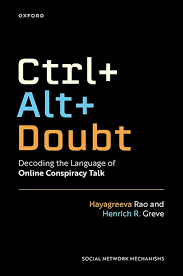
Ctrl+Alt+Doubt
Decoding the Language of Online Conspiracy Talk
Summary
Ctrl+Alt+Doubt: Decoding the Language of Online Conspiracy Talk (Oxford UP, 2026) offers a new way to understand why conspiracy theories grow and persist. Rather than treating them as cognitive errors, psychological pathologies, or products of echo chambers, Rao and Greve analyze conspiracy theories as linguistic constructions, that is as stories built from recognizable semantic patterns. Drawing on cases from COVID-19 and the Black Lives Matter protests, Rao and Greve show that conspiracy theorizing is a form of bricolage. People tinker with cultural fragments to craft explanations that reduce uncertainty and threat. New conspiracy beliefs are most likely to take hold when they are linguistically close to beliefs people already hold. The book traces how conspiracy theories spread through superspreaders, fear-laden language, bots, and shared hashtags, revealing conspiracy theorizing as a form of proto-coordination that generates community, amplifies outrage, and enables collective sensemaking among opponents of social movements.


Comments